


Vietnam Visa for Russian Citizens (2026)
By VietnamVisaEasy Visa Team · 2025-08-02 · Updated 2026-11-08
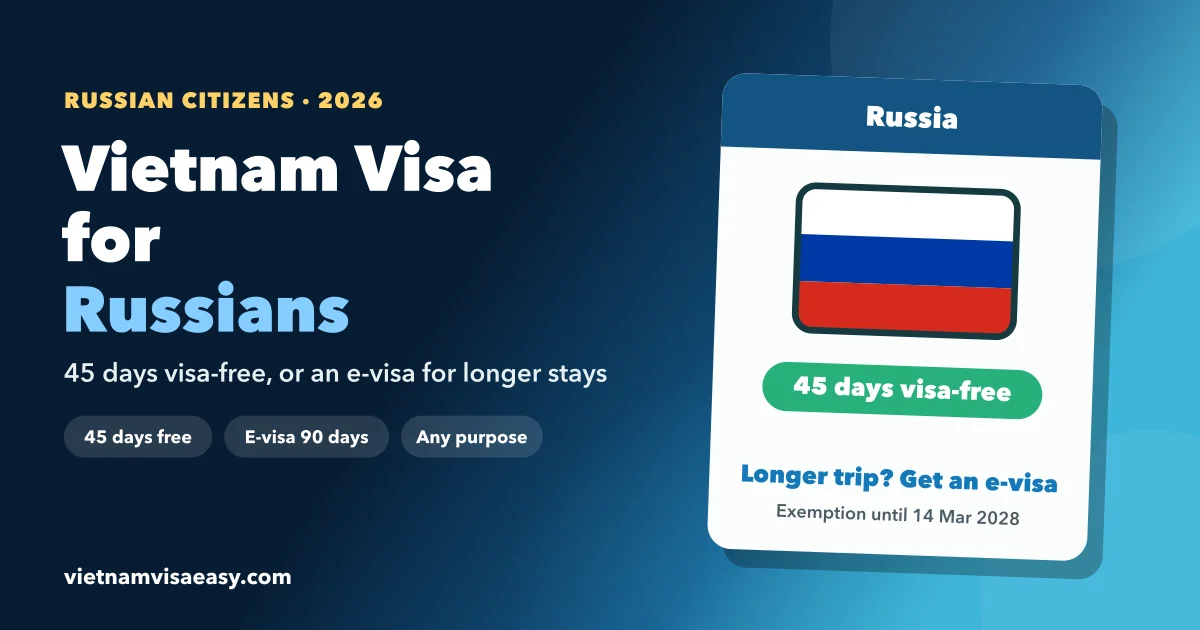
Many Russian travelers look up the Vietnam visa for Russians before a trip, but most do not need one. Russia is on Vietnam's visa exemption list, so a holiday of up to 45 days needs only a valid passport. The e-visa becomes useful for longer stays and for trips with side visits abroad. This guide explains the exemption, when an e-visa is the better choice, and how to apply.
Do Russians need a visa for Vietnam?
Not for stays of up to 45 days. Under Resolution 44/NQ-CP, citizens of 12 countries, including Russia, can enter Vietnam visa-free for up to 45 days for any short-stay purpose. The resolution runs from 15 March 2025 to 14 March 2028.
| Your trip | What you need |
|---|---|
| Up to 45 days, single visit | Passport only, visa-free |
| More than 45 days | E-visa, up to 90 days |
| Leaving and coming back within 90 days | Multiple-entry e-visa, or a new visa-free entry each time |
| Work or long-term stay | A sponsored visa, not the e-visa |
The exemption covers ordinary passports. Diplomatic and official passports have separate agreements. The full list of exempt countries is in our Vietnam visa exemption guide.
When is an e-visa better than the Vietnam visa for Russians exemption?
When your stay will be longer than 45 days, or your plans may change. The visa-free stay cannot be extended by a tourist alone. If there is any chance you will stay longer, an e-visa avoids an overstay.
Common reasons Russian travelers choose the e-visa:
- A winter stay of 2–3 months in Nha Trang, Phu Quoc or Da Nang.
- A trip with side visits to Cambodia, Laos or Thailand, using a multiple-entry e-visa.
- Uncertain return dates, where 90 days gives a safe margin.
- A visa run plan that the traveler wants to avoid altogether.
The e-visa is valid for up to 90 days. The government fee is US$25 for single entry and US$50 for multiple entry, the same for 30 or 90 days.
How do Russians apply for the e-visa?
Online, in about 15 minutes, before you fly.
- Open the official e-visa portal or use an agency that files on the same system.
- Upload a photo of your passport data page, with both machine-readable lines visible.
- Upload a recent portrait photo on a white background, without glasses.
- Enter your name in Latin letters exactly as in the passport's machine-readable lines.
- Choose the entry port where you will land, such as Cam Ranh, Phu Quoc or Tan Son Nhat.
- Pay the government fee and save the application code.
Normal processing takes several working days. If your trip is close, our Vietnam urgent visa processing guide explains the faster speeds.
Can Russian travelers pay for the e-visa online?
Check your card first. The government fee is paid by international card on the portal. Many cards issued by Russian banks have not worked for foreign online payments since 2022, so a payment may fail even when the form is correct.
Practical options:
- Use a card issued outside Russia, if you have one.
- Ask a relative or friend abroad to pay the government fee for you on the official portal.
- Use an agency that offers other payment methods and files the application for you.
Do not retry a failed payment many times. Check whether money left your account first, so you do not pay twice.
What do Russian travelers get wrong most often?
Name spelling and dates. These problems cause most delays:
- Transliteration. Use the spelling in the passport's machine-readable lines, not another Latin spelling of the same name.
- Passport validity. Vietnam asks for at least 6 months from arrival. An internal Russian passport cannot be used for travel to Vietnam.
- Entry port. Charter flights often land at Cam Ranh or Phu Quoc. Choose the airport where you land, not a transit airport.
- Dates. Enter the date you land in Vietnam. A late arrival does not move the end date of the e-visa.
How do you count the 45 days?
The day you arrive counts as day 1. If you land on 1 December, day 45 is 14 January, and you must leave by then. Staying even 1 day longer is an overstay, which leads to fines at departure and can affect future visits.
If you leave Vietnam and come back, a new visa-free stay usually starts on re-entry, but border officers can refuse entry to travelers who appear to live in Vietnam on repeated exemptions. For long stays, an e-visa is the safer route. Our visa extension guide explains why extending inside Vietnam is rarely possible.
What should you carry at the border?
Your passport and, if you have one, the e-visa printout. Border officers may also ask for a return or onward ticket and your hotel address, especially for visa-free entries. Keep them on your phone.
If you entered visa-free and want to stay longer, plan a trip out of Vietnam before day 45, or apply for an e-visa before your next entry. Our passport validity guide covers the passport rules in detail.
Frequently asked questions
Do Russian citizens need a visa for Vietnam?
Not for stays of up to 45 days. Russian ordinary passport holders are visa-exempt under Resolution 44/NQ-CP.
When does a Russian traveler need a Vietnam e-visa?
When the stay will be longer than 45 days, or when you want to leave and re-enter on one visa within up to 90 days.
Can I extend the 45-day visa-free stay?
Not by yourself as a tourist. If you may stay longer, get an e-visa for up to 90 days before you travel.
Where do Russians apply for the e-visa?
On the official portal evisa.gov.vn, or through an agency that files on the same system.
Need your visa today?
Urgent options from 30–60 minutes, also on weekends & holidays.
Comments (0)