


Vietnam Visa for Japanese Citizens
By VietnamVisaEasy Visa Team · 2025-08-02 · Updated 2026-11-08
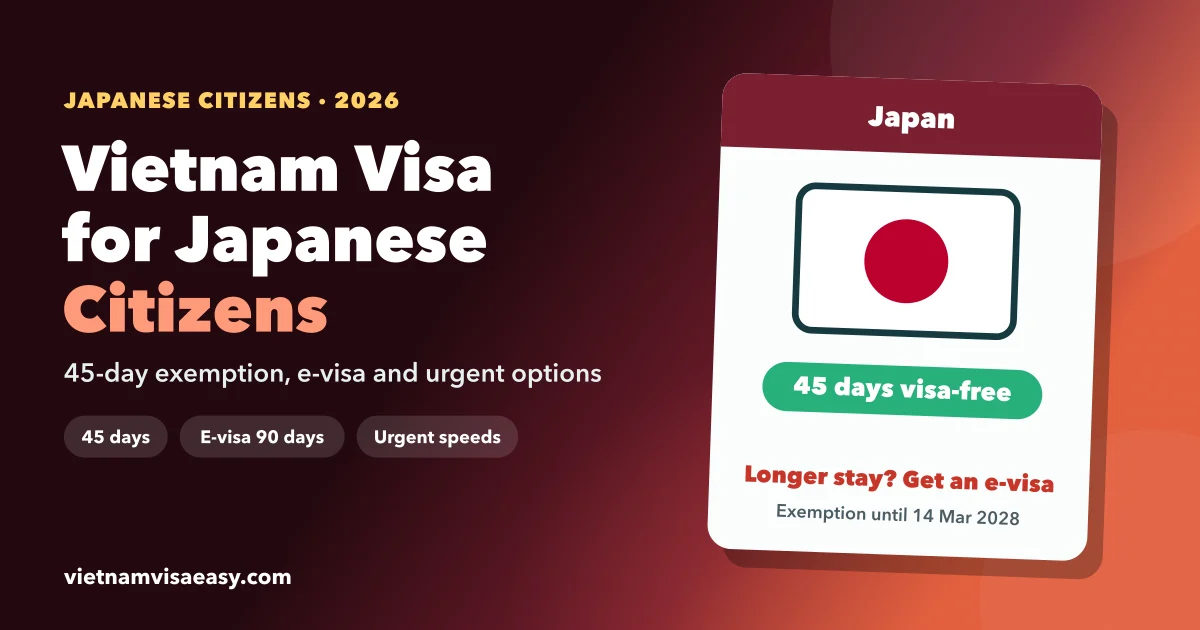
The Vietnam visa for Japanese citizens is simple for most trips: there is no visa to arrange. Japan is on Vietnam's exemption list, so a holiday or business visit of up to 45 days needs only a valid passport. An e-visa is useful for longer stays and for trips with side visits abroad. This guide explains the exemption, when to choose an e-visa, and how to apply from Japan.
Do Japanese citizens need a visa for Vietnam?
Not for stays of up to 45 days. Resolution 44/NQ-CP lets citizens of 12 countries, including Japan, enter Vietnam visa-free for up to 45 days for any short-stay purpose. It runs from 15 March 2025 to 14 March 2028.
| Your trip | What you need |
|---|---|
| Holiday or business trip up to 45 days | Passport only, visa-free |
| Stay longer than 45 days | E-visa, up to 90 days |
| Several entries within 90 days | Multiple-entry e-visa |
| Work, study or long-term stay | A sponsored visa |
The exemption covers ordinary Japanese passports. The full list of exempt countries is in our Vietnam visa exemption guide.
When is an e-visa better than the Vietnam visa for Japanese citizens exemption?
When the stay may be longer than 45 days or include re-entry. A tourist cannot extend the visa-free stay alone, so an e-visa avoids an accidental overstay.
Typical cases:
- A long stay of 2–3 months, for example for language study or a family visit.
- A trip from Vietnam to Cambodia, Laos or Thailand and back.
- A business assignment with uncertain dates.
The e-visa is valid for up to 90 days, not only 30. The government fee is US$25 for single entry and US$50 for multiple entry, the same for any validity up to 90 days.
How do you apply for the e-visa from Japan?
Online, before you fly.
- Open the official e-visa portal or use an agency that files on the same system.
- Upload a photo of your passport data page, with the machine-readable lines visible.
- Upload a recent portrait photo on a white background, without glasses.
- Enter your name in Latin letters exactly as in the passport's machine-readable lines.
- Choose the Vietnamese airport where you land, such as Noi Bai, Tan Son Nhat or Da Nang.
- Pay the government fee and save the application code.
Normal processing takes several working days. For a trip within days, our Vietnam urgent visa processing guide shows the faster speeds.
What are Vietnamese office hours in Japan time?
Vietnam is 2 hours behind Japan, all year. Offices work Monday to Friday, 08:00–11:30 and 13:30–18:30 Vietnam time.
| Vietnam time | Japan time (JST) |
|---|---|
| 08:00, offices open | 10:00 |
| 11:00, 1-day cutoff | 13:00 |
| 15:00, weekend service cutoff | 17:00 |
| 18:00, last cutoff for 30–60 minutes | 20:00 |
| 18:30, offices close | 20:30 |
Because the hours overlap with your working day, an urgent e-visa can often be completed the same afternoon.
Where do flights from Japan land in Vietnam?
Mostly at Hanoi, Ho Chi Minh City and Da Nang. Direct flights connect Tokyo, Osaka, Nagoya and Fukuoka with Noi Bai (Hanoi) and Tan Son Nhat (Ho Chi Minh City), and some routes serve Da Nang. All three are on the official list of e-visa ports of entry.
For visa-free travelers, the airport makes no difference: you show your passport at the immigration counter. For e-visa holders, the entry port on the e-visa must be the airport where you actually land. If you connect through Seoul, Taipei or Bangkok, choose the Vietnamese airport at the end of the trip, not the transit city. Our ports of entry guide lists every gate.
Can Japanese families use the exemption with children?
Yes, every Japanese passport holder is covered, including children. A child with their own passport can enter visa-free for up to 45 days. In families with mixed nationalities, check each passport separately: a Japanese parent may enter visa-free while a spouse or child with another nationality needs an e-visa.
How do you count the 45 days?
The arrival day is day 1. If you land on 1 April, day 45 is 15 May, and you must leave by then. Overstaying, even by 1 day, leads to fines at departure. Plan your exit flight with a margin, and check the entry stamp in your passport.
If you leave and come back, a new visa-free stay usually starts on re-entry, but repeated back-to-back entries can draw questions at the border. For long stays, an e-visa is the cleaner route. Our visa extension guide explains why extensions inside Vietnam are rarely possible.
What should you check before you travel?
Your passport and your route.
- The passport is valid for at least 6 months from arrival and has a blank page.
- You have a return or onward ticket, which airlines and border officers may ask to see.
- If you use an e-visa, the entry port is the Vietnamese airport where you land, not a transit hub.
- The e-visa start date is on or before your landing date.
Our passport validity guide explains the passport rules in detail.
Frequently asked questions
Do Japanese citizens need a visa for Vietnam?
No, for stays of up to 45 days. Japan is covered by Resolution 44/NQ-CP until 14 March 2028.
Is the e-visa limited to 30 days?
No. The e-visa can be issued for up to 90 days, with single or multiple entry.
Can I extend the 45 days inside Vietnam?
Usually not as a tourist. If you may stay longer, get an e-visa before you travel.
What are Vietnamese office hours in Japan time?
Vietnam is 2 hours behind Japan, so offices work from 10:00 to 20:30 Japan time on weekdays, with a midday break.
Need your visa today?
Urgent options from 30–60 minutes, also on weekends & holidays.
Comments (0)